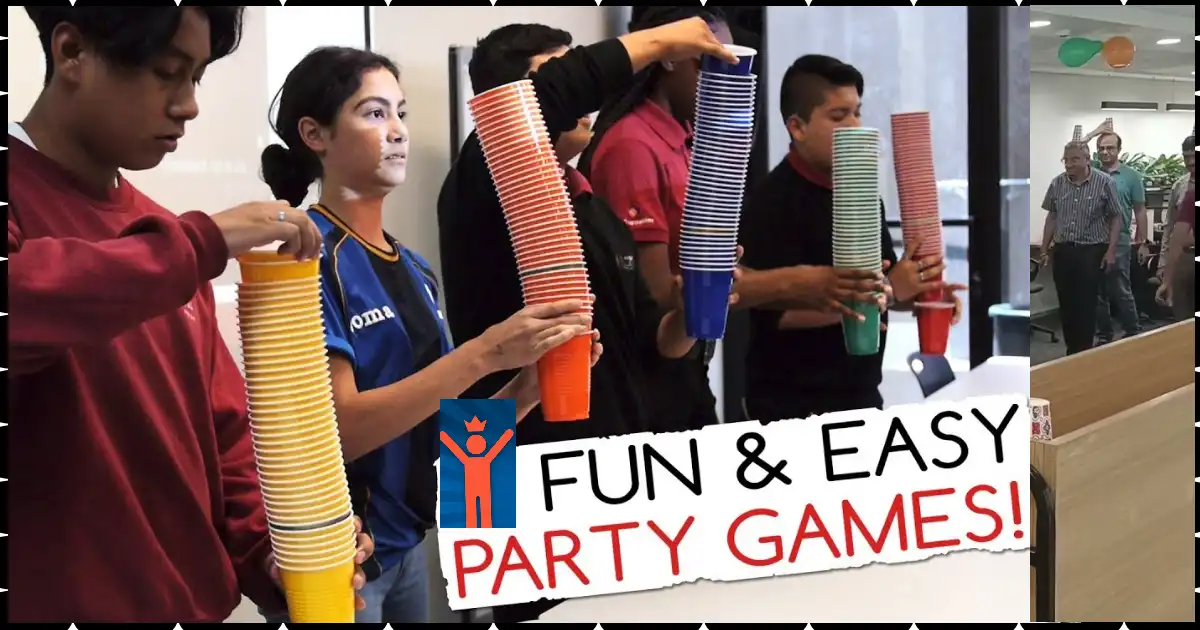
You and your team members have worked really hard for the last few months, and now you want to throw a party so you and your team members/cowerkers or friends can relax. I think that is a great idea to reset, but throwing a party is not enough; you are inviting large groups of adults, so you are responsible for their entertainment.
In my opinion, there is only 1 way to not throw a boring party that people will regret coming to. You have to include fun Activities or Games that can be played by a large group.
You also have to remember there are no children, so you need to find games that your friends who are adult i presume, will like and engage in instead of just watching.
And there we come to your rescue with 45 Best Indoor Party Games which can be played by Large Groups and are for adults. We have included 20 Party Games which we think are best for your friends or coworkers, and we have also included 25 Most Popular Party Games in America, United Kingdom, Italy, France, and Germany,
Table of Contents
More Games and Activities Ideas List
Need to Know
Before we give the List of games, here are some things you need to know.
Q: How do you choose a game that everyone will actually want to play?
A: The secret is offering “low-pressure participation.” Avoid games that force every single person to perform solo or be put on the spot if they are shy.
Team-based games (like Codenames or Reverse Charades) are perfect because extroverts can take the lead while introverts can comfortably contribute without being the center of attention.
Also, look for games with simultaneous action (like Fishbowl or Telestrations) where everyone is engaged at the same time, eliminating boring wait times.
Q: What are the best games if you have zero time to prep or buy anything?
A: If you need to start playing immediately with no supplies, go for conversational or phone-based games. Two Truths and a Lie (Mass Edition), Story-Building Relay, or Human Bingo require only conversation or a piece of paper.
Alternatively, digital games like Heads Up! or Kahoot! (where everyone uses their own smartphone) require zero physical setup and can entertain an entire living room instantly.
Q: How do you handle games when alcohol is involved?
A: If your group is drinking, ditch anything with complex rules, long setup times, or intense strategy. Stick to games that are fast, funny, and simple to understand even if someone is distracted.
Cards Against Humanity, What Do You Meme?, and Sip or Spill are staples for a reason—they are low-stakes, highly social, and thrive in a relaxed, cocktail-friendly environment.
Q: How long should a large group party game last?
A: Aim for a game that lasts between 20 and 60 minutes(according to the size of your group). Anything shorter might not give everyone a chance to fully participate, and anything longer risks guests losing focus, checking their phones, or wandering off to the snack table.
The best group games are those where people are having so much fun they demand to play a second round, rather than waiting for the first round to finally end.
Q: What if you have a mix of close friends and people who don’t know each other?
A: Start with an icebreaker game that forces mingling but gives people a structured reason to talk.
Sticker Stalker (trying to secretly place stickers on guests) or Human Bingo (finding guests who match specific traits) get people interacting naturally. Save the deeper conversational games or heavy team-based games for after everyone has warmed up to each other.
Q: What equipment do you typically need to have on hand?
A: You can pull off a massive game night with just a few household staples:
- a stack of paper or index cards,
- plenty of pens,
- a bowl/hat, and
- a timer (your phone works perfectly).
If you want to elevate the night, having a laptop connected to a TV (for PowerPoint Night or Jackbox Games) is highly recommended.
20 Best Large Groups Indoor Party Games for Adults
1. PowerPoint Night
- Why choose this game: It’s hilarious, highly creative, and perfect for inside jokes.
- Group size: 4–10 players
- Game length: 1–2 hours
- Tools required: A laptop, a TV or projector, and presentation software (PowerPoint, Google Slides, etc.).
How to play
Before the gathering, every guest creates a short (3 to 5-minute) slideshow on a highly subjective, funny, or absurd topic of their choice. Examples include “Rating my friends as dog breeds,” “Historical figures I could beat in a fistfight,” or “Why [Movie] is secretly a masterpiece.” At the party, guests take turns presenting their slides to the group, taking it as seriously as a corporate board meeting, and fielding questions at the end.
Why this game is great
It allows everyone to showcase their unique sense of humor and creativity in a structured yet wonderfully chaotic format. Listening to your friends passionately argue a ridiculous, niche topic using bar charts and bullet points sparks incredibly funny conversations and guarantees a night of non-stop laughter.
2. Fishbowl
- Why choose this game: It’s a fast-paced, high-energy mashup that gets everyone out of their shells.
- Group size: 6–20 players
- Game length: 30–45 minutes
- Tools required: Slips of paper, pens, a bowl (or hat), and a timer (smartphone).
How to play
Everyone writes 3 to 5 nouns or phrases on slips of paper and tosses them into a bowl. Divide into two teams. The game is played in three rounds, using the exact same slips of paper each time. Teams get one minute to guess as many words as possible.
- Round 1 (Taboo): Describe the word without saying it.
- Round 2 (Charades): Act out the word without making a sound.
- Round 3 (Password): Say only one word as a clue. The team with the most total points at the end of round three wins.
Why this game is great
Because you use the same set of words for all three rounds, a shared memory and inside jokes develop instantly. By the third round, just winking or saying a seemingly unrelated word might make your team instantly guess a ridiculously complex phrase, making the gameplay highly rewarding, hysterical, and deeply engaging.
3. Human Bingo
- Why choose this game: It’s an elite, low-pressure icebreaker for mingling.
- Group size: 10–50+ players
- Game length: 15–30 minutes
- Tools required: Pre-printed Bingo cards and pens for each player.
How to play
Create and print out bingo cards where each square contains a quirky trait, skill, or life experience (e.g., “has run a marathon,” “can juggle,” “has broken a bone,” or “speaks three languages”). Hand one to every guest as they arrive. Players must mingle and talk to each other to find someone who fits the description in a square, having them sign their name there. A person can only sign your card once. The first player to get a full line (or a full board) yells “Bingo!” and wins.
Why this game is great
It forces people to step away from the snack table and talk to strangers in a goal-oriented, non-awkward way. It completely bypasses boring small talk, giving guests an immediate conversation starter that often leads to fascinating discoveries and deeper connections right from the start of the party.
4. Two Truths and a Lie (Mass Edition)
- Why choose this game: It’s a classic, zero-prep game driven by storytelling and deception.
- Group size: 8–30 players
- Game length: 30–60 minutes
- Tools required: None (optional: a microphone for very large rooms).
How to play
Each person takes the floor and presents three statements about themselves to the entire room. Two of the statements must be completely true, and one must be a total fabrication. The rest of the room gets a brief moment to interrogate the speaker, asking for specific details to catch them in a lie. After the interrogation, the room votes by a show of hands on which statement is the lie. The speaker then reveals the truth.
Why this game is great
It scales effortlessly for larger groups without requiring any props, setup, or table space. It thrives on the element of surprise, letting quiet friends shock the group with wild, unbelievable true stories while attempting to bluff their way through totally mundane lies. It’s a fantastic way to learn hilarious secrets about people you thought you knew well.
5. Escape the Box / Tabletop Escape Rooms
- Why choose this game: It’s highly cooperative, intellectually stimulating, and intensely competitive.
- Group size: 4–6 players per box (easily scaled up by buying multiple copies).
- Game length: 1–2 hours
- Tools required: Store-bought tabletop escape kits (e.g., EXIT: The Game, Unlock!), scratch paper, pens, and a timer.
How to play
Divide the party into small teams of 4 to 6 people. Hand each team an identical copy of a tabletop escape room box and have them sit at separate stations. Start a master timer. Teams must sift through documents, crack ciphers, and solve physical or logic puzzles to uncover the mystery or “escape.” The first team to successfully complete the final puzzle wins.
Why this game is great
It channels the immersive thrill of a real escape room into a cozy living room setting while adding a brilliant layer of competition. Racing against other teams adds massive energy and urgency to the room, forcing groups to communicate effectively, collaborate, and utilize everyone’s different types of intelligence to secure the win.
6. Sticker Stalker
- Why choose this game: It’s a brilliant, passive game that runs in the background while your guests socialize normally.
- Group size: 8–50+ players
- Game length: The entire duration of the party (until someone wins).
- Tools required: One identical sheet of stickers for every guest.
How to play
As guests arrive, hand each of them a sheet of stickers (ideally something small but visible). The objective is to secretly place all of your stickers onto other guests without them noticing. If you are caught in the act of sticking someone, you must take your sticker back. If a guest realizes a sticker is on them, they can just take it off. The first person to successfully empty their entire sheet of stickers onto other people wins the game.
Why this game is great
It adds a hilarious layer of paranoia and mischief to your gathering without interrupting the flow of the evening. It forces people to get physically close and interact with guests they might not normally talk to, all while trying to casually lean against them to plant a sticker. When someone finally realizes they have five stickers on their back, the room erupts in laughter.
7. Mini Murder Mystery
- Why choose this game: It provides a fully immersive, theatrical experience where everyone gets to play a part.
- Group size: 6–20 players
- Game length: 1.5–3 hours
- Tools required: A boxed or printable murder mystery kit, character sheets, name tags, and optional props/costumes.
How to play
The host assigns a character to each guest before the party so they can dress the part. Upon arrival, a “murder” is announced. Over the course of the evening, guests are given new clues and objectives. They must mingle, interrogate each other while staying in character, and form alliances to figure out who the killer is—while the killer tries to deflect suspicion. The game ends with everyone making their final accusations before the truth is revealed.
Why this game is great
It transforms a standard dinner party into an interactive movie where your friends are the stars. Giving people a character to play removes the pressure of typical socializing, making it an incredible icebreaker. The drama, the terrible accents, and the shifting suspicions make it a highly memorable night.
8. Lip Sync Battle
- Why choose this game: It brings out massive, stadium-level energy without requiring anyone to actually know how to sing.
- Group size: 4–20 players
- Game length: 1–2 hours
- Tools required: A sound system/speakers, a playlist, an open “stage” area, and optional props (hairbrushes, sunglasses, fake microphones).
How to play
Guests are divided into teams (or compete solo). Each team selects a popular, high-energy song and gets a few minutes to quickly choreograph a routine. When it’s their turn, they take the stage to aggressively mime-sing the lyrics, utilizing dramatic facial expressions, wild dancing, and props. The rest of the party acts as the audience and judges, crowning the winner based on passion, comedy, and sync accuracy.
Why this game is great
It is pure, uninhibited fun. It allows the most extroverted people to shine while giving quieter guests an excuse to let loose and be goofy. Watching your friends take a melodramatic pop ballad or a heavy rap song entirely too seriously is guaranteed to have the whole room crying with laughter.
9. Reverse Charades
- Why choose this game: It flips a classic game completely upside down, turning it into loud, uncoordinated chaos.
- Group size: 6–16 players (split into two teams)
- Game length: 30–45 minutes
- Tools required: Word cards (or a charades app) and a timer.
How to play
Instead of one person acting out a word for the group to guess, the entire team acts out the word simultaneously while one designated person tries to guess it. Set a timer for 60 seconds. The team frantically mimes the word together while the single guesser shouts out answers. The team that guesses the most words across a few rounds wins.
Why this game is great
Standard charades can be intimidating for shy people who hate being put on the spot. This version completely removes that pressure by putting the spotlight on the group as a whole. Watching six people try to silently coordinate how to act out a “washing machine” or a “T-Rex” is visually hysterical and results in spectacular communication breakdowns.
10. Trading Floor
- Why choose this game: It is a high-octane, adrenaline-fueled game of screaming, trading, and quick thinking.
- Group size: 6–12 players
- Game length: 20–40 minutes
- Tools required: A specialized trading card game (like Pit) or a custom deck of playing cards (sets of 9 identical cards for each player), and a loud bell (optional).
How to play
The goal is to corner the market by collecting a full set of one specific commodity (e.g., all 9 Wheat cards or all 9 of the number ‘4’ in a deck). Players are dealt mixed hands. When the round starts, there are no turns. Everyone simultaneously yells out how many cards they want to trade (e.g., “Two! Two! Trading two!”) and blindly swaps facedown cards with anyone else offering the same amount. The first person to get a matching hand hits the bell and yells, “Corner!”
Why this game is great
It is incredibly loud, fast, and intensely competitive. The room instantly turns into a chaotic Wall Street stock exchange, breaking the ice within seconds. It requires zero trivia knowledge or deep strategy—just quick reflexes and the willingness to shout over your friends, making it a brilliant palate cleanser between slower party games.
11. Caption This
- Why choose this game: It guarantees belly laughs and allows everyone’s unique sense of humor to shine, turning inside jokes or awkward photos into pure comedy.
- Group size: 4–15+ players
- Game length: 20–45 minutes
- Tools required: A TV or projector to display images, a collection of funny/random photos, and either paper and pens or smartphones (using a digital submission tool).
How to play
The host displays a random, awkward, or hilarious photo on the big screen. The photo can be sourced from the internet, old Facebook albums, or even pictures taken earlier that night. Every player has one to two minutes to come up with the funniest caption they can think of and submits it anonymously to the host (either by handing them a folded piece of paper or texting it to them). The host reads all the captions aloud, and the group votes on the best one. The person with the most winning captions at the end of the slideshow wins.
Why this game is great
This game is a fantastic icebreaker because the anonymity removes the pressure of “performing” in front of the group. Even the quietest guests often come up with the most savage or hilarious one-liners. It’s entirely customizable to your group’s humor—you can keep it family-friendly or make it incredibly edgy depending on the photos and the crowd.
12. What’s in the Box?
- Why choose this game: It relies entirely on suspense and the hilariously inaccurate reactions of the players, making it just as fun to watch as it is to play.
- Group size: 4–10 players
- Game length: 15–30 minutes
- Tools required: A cardboard box with holes cut out for hands, a blindfold, and a variety of mystery objects with distinct textures (e.g., peeled grapes, cooked spaghetti, a fuzzy toy, slime, or a hairbrush).
How to play
Before the game, prepare a box by cutting two holes in one side just big enough for someone’s hands to fit through. During a player’s turn, blindfold them (or have them face away from the box’s open side). Place a mystery object inside the box. The player must then reach inside, touch the object without looking, and try to guess what it is within a set time limit (usually 30 to 60 seconds).
Why this game is great
The psychological buildup is the star of this game. Because the player cannot see what they are touching, completely mundane objects feel terrifying or strange. Cold, cooked spaghetti suddenly feels like worms, and a damp sponge feels like something alive. The contrast between the player’s sheer panic and the audience knowing it’s just a piece of fruit makes for incredible entertainment and great photo opportunities.
13. Wink Murder
- Why choose this game: It requires almost no setup and adds an undercurrent of suspense and sneaky interaction to the party without interrupting other conversations.
- Group size: 6–20+ players
- Game length: 15 minutes to an ongoing background game lasting all night
- Tools required: A deck of cards or small slips of paper to assign roles.
How to play
Distribute the slips of paper or cards to assign secret roles. One person is the “Murderer,” one person is the “Detective” (who announces their role), and everyone else is a “Civilian.” The Murderer’s goal is to eliminate Civilians by making direct eye contact with them and giving a subtle wink. If a Civilian is winked at, they must wait a few seconds and then dramatically “die” (slumping in their chair or falling to the floor). The Detective must observe the room and try to identify the Murderer before everyone is eliminated.
Why this game is great
Wink Murder forces everyone to pay close attention to each other, resulting in lots of intense, paranoid eye contact and sudden bursts of theatrical acting when someone “dies.” It’s highly versatile; you can play it as a seated, focused activity, or you can have it running in the background while people are eating, chatting, or listening to music, which creates a highly immersive party atmosphere.
14. Live Trivia (e.g., Kahoot!)
- Why choose this game: It brings the energy of a professional pub quiz right to your living room in a modern, tech-friendly, and highly competitive format.
- Group size: 3–50+ players
- Game length: 20–45 minutes
- Tools required: A laptop connected to a TV (for the main game board), smartphones for every player, and a trivia platform like Kahoot! or Slido.
How to play
The host sets up a trivia game on a platform like Kahoot! prior to the party. This can be general knowledge, pop culture, or a highly personalized quiz about the friend group. The host displays the game screen on the TV, which shows a unique PIN. Players go to the platform’s website on their smartphone browsers, enter the PIN, and type in a nickname. As questions appear on the TV, players race to select the correct multiple-choice answer on their phones. Points are awarded for both accuracy and speed.
Why this game is great
Almost everyone loves trivia, and using smartphones completely eliminates the need for messy paper scorecards or shouting over one another. The real-time leaderboard creates a fierce (but friendly) competitive atmosphere. Plus, if you take the time to write custom questions about the guests (e.g., “Who accidentally set the toaster on fire in college?”), it becomes an unforgettable, personalized experience.
15. Sip or Spill
- Why choose this game: It is a fantastic conversational game that encourages storytelling, vulnerability, and lots of laughs without forcing anyone out of their comfort zone.
- Group size: 4–12 players
- Game length: 30–60+ minutes
- Tools required: Drinks of choice (alcoholic or non-alcoholic) and a prepared list of juicy, thought-provoking, or funny questions.
How to play
Players sit in a circle with their drinks. Taking turns, one player draws a card or reads a question from a list directed at either a specific person or the whole group. The questions should be probing or slightly embarrassing (e.g., “What is your most irrational dealbreaker on a date?” or “What is a secret you kept from your parents growing up?”). The person asked must make a choice: they can either answer the question honestly and in full detail (“Spill”), or they can refuse to answer and take a sip of their drink (“Sip”).
Why this game is great
It is a massive upgrade to standard “Truth or Dare” because it removes the pressure of physical dares while still delivering the tea. The genius of the game lies in its built-in safety net: if a question is genuinely too uncomfortable, the player can easily opt out by taking a sip, keeping the vibe light and fun. It often leads to incredible, unexpected stories and helps friends bond on a much deeper level.
16. Emoji Charades
- Point: A modern, text-based twist on a classic that tests players’ pop-culture knowledge and their ability to decipher digital hieroglyphics.
- Group size: 3–15+ players
- Game length: 15–30 minutes
- Tools required: A smartphone or tablet to build the clues, and a TV/projector (or group chat) to display the emojis to the group.
How to play
One person (or team) prepares a sequence of emojis that represents a well-known movie, song title, book, famous quote, or pop-culture moment. They display this string of emojis to the rest of the group. The players then race to decode the visual puzzle and shout out the correct answer. The first person to guess the exact phrase wins the round and earns a point, and the role of the “emoji master” can rotate to the winner.
Why this game is great
It takes a language everyone uses daily—emojis—and turns it into a hilarious brain-teasing puzzle. It is incredibly funny to see how differently people interpret the same symbols, and the “aha!” moment when someone finally connects a random string of icons to a famous movie title is deeply satisfying. It requires minimal physical setup, can be played from the couch, and is easily customizable to the specific interests or inside jokes of your particular friend group.
17. Blind Karaoke
- Point: A high-energy, musically chaotic game that separates the true fans from the casual listeners and guarantees massive laughs.
- Group size: 4–15 players
- Game length: 30–60 minutes
- Tools required: A karaoke machine or TV/laptop with YouTube, a microphone, and a host to control the volume.
How to play
A player selects a popular, well-known song and begins singing along with the backing track and lyrics displayed on the screen. Midway through a verse or chorus, the host suddenly mutes the volume and turns off or covers the screen. The singer must continue singing the song a cappella, trying to keep the exact tempo and lyrics going from memory. After 10 to 15 seconds, the host unmutes the track. If the singer is still perfectly on beat and pitch-matched with the actual song, they win.
Why this game is great
Blind Karaoke is pure, unadulterated comedic joy. Almost everyone naturally speeds up or slows down when the backing music cuts out, leading to highly entertaining reveals when the track comes back on and the singer is completely out of sync. It takes the typical pressure off hitting perfect notes and shifts the focus entirely to memory, rhythm, and confidence, making it accessible and fun even for people who are notoriously terrible singers.
18. Sock Wrestling
- Point: A hilariously physical, energy-burning competition that brings out everyone’s competitive streak in a safe, deeply silly way.
- Group size: 4–12 players (played 1-on-1 in a tournament style)
- Game length: 15–30 minutes
- Tools required: Carpeted floor or padded mats, and everyone must be wearing socks.
How to play
Clear a large space on a soft, carpeted floor to ensure safety. Two players enter the “ring” on their hands and knees, both wearing socks. On the count of three, the players wrestle with one singular objective: be the first to pull a sock off the other person’s foot. Standing up on your feet is strictly prohibited—players must remain on their knees or seated on the ground. The winner advances to the next round of the tournament until an ultimate champion is crowned.
Why this game is great
It is an absolute riot that quickly dissolves into fits of laughter and frantic scrambling. It bridges the gap between childhood roughhousing and party games, serving as a fantastic late-night energy booster when conversations start to lull. Because standing isn’t allowed, it levels the playing field significantly, meaning absolute size and strength matter much less than agility, strategy, flexibility, and pure determination.
19. Story-Building Relay
- Point: A creative, rapid-fire improv game that inevitably spirals into an absurd, unpredictable, and entirely unique narrative.
- Group size: 5–15 players
- Game length: 15–20 minutes
- Tools required: None (though recording the audio on a phone is highly recommended to capture the final story).
How to play
Players sit in a circle. One person starts a story by saying a single sentence to set the scene (e.g., “It was a normal Tuesday until the toaster started talking.”). The person next to them must immediately follow up with the next sentence, building logically on what was just said. The story continues rapidly around the circle. If someone hesitates for more than three seconds, breaks character, or makes an impossible leap that ruins the plot, they are eliminated or get a “strike.”
Why this game is great
You never know where the plot is going to go, making it a brilliant exercise in collective imagination. A story that starts as a mundane trip to the grocery store will almost always devolve into a sci-fi alien invasion, a bizarre romance, or a ridiculous melodrama within three rounds. It requires quick thinking, encourages active listening, and completely breaks down social barriers because everyone looks equally silly trying to keep the chaotic plot alive under pressure.
20. Marshmallow Tower
- Point: A classic team-building challenge that combines engineering, strategy, and high-pressure construction under a ticking clock.
- Group size: 4–20 players (divided into small teams of 3–5)
- Game length: 20–30 minutes
- Tools required: Dry spaghetti noodles, large marshmallows, mini marshmallows, a measuring tape, and a timer.
How to play
Divide the group into equal teams and give each team the exact same amount of supplies (for example: 20 sticks of dry spaghetti, one large marshmallow, and a handful of mini marshmallows). Set a timer for 15 minutes. Teams must work together to build the tallest freestanding structure possible using only the provided materials. The catch is that the entire structure must support itself without being taped down or held up, and the one large marshmallow must be placed at the very highest peak of the tower.
Why this game is great
It is a brilliant mix of frantic planning, delicate physical execution, and inevitable architectural disasters. The game forces people to communicate clearly, debate strategies, and assign roles (the planner, the builder, the stabilizer) organically. Watching a rival team’s impressive, three-foot tower slowly lean and catastrophically collapse with exactly ten seconds left on the clock provides incredibly dramatic and highly entertaining party moments.
10 Most Popular Indoor Party Games in America
21. Codenames
- Point: A brilliant test of lateral thinking, word association, and team synergy that completely changes how you communicate with your friends.
- Group size: 4–8+ players (best with 6 or 8)
- Game length: 15–30 minutes
- Tools required: Codenames board game (or the official digital/web version).
How to play
Players split into two teams (Red and Blue), each led by a “Spymaster.” A grid of 25 word cards is laid out on the table. Only the two Spymasters can see the secret map showing which words belong to their team, which belong to the opponent, and which is the instant-death “Assassin” word. The Spymaster must give a one-word clue followed by a number (e.g., “Ocean, 3”) to connect multiple words on the board (like “Water,” “Deep,” and “Whale”). The team must then debate and touch the cards they think their Spymaster meant without accidentally picking the other team’s words or the Assassin.
Why this game is great
Codenames strikes the perfect balance between quiet, intense concentration and loud, chaotic debates. Watching your team logically talk themselves out of the correct answer and choose the worst possible word is both agonizing and hilarious. Because the clues are limited to a single word, it creates fascinating insights into how your friends’ brains work and what weird associations they make. It is deeply replayable, highly addictive, and easy to teach to non-gamers within three minutes.
22. Cards Against Humanity
- Point: Pushes boundaries, tests dark humor, and guarantees shock-value laughs by letting players create the most absurd, inappropriate sentences possible.
- Group size: 4–20+ players
- Game length: 30–90 minutes
- Tools required: A standard Cards Against Humanity deck.
How to play
Every player is dealt a hand of white “answer” cards. One player acts as the “Card Czar” for the round and draws a black “prompt” card, reading it aloud to the group (e.g., “What is Batman’s guilty pleasure?”). The other players look at their hands and submit their funniest, most outrageous white card face down. The Card Czar shuffles the submitted answers, reads them aloud one by one within the context of the prompt, and chooses their favorite. The winner gets a point, and the role of Czar rotates to the left.
Why this game is great
This game is the ultimate, low-friction icebreaker for crowds with a wicked sense of humor. Its genius lies in its simplicity: the cards do the heavy lifting for the jokes, meaning even people who aren’t naturally quick-witted can drop perfectly timed, devastatingly funny punchlines. It requires absolutely no strategy, people can jump in and out of the game at any time without disrupting the flow, and it often leads to people laughing until they are in tears.
23. Jackbox Games (e.g., Quiplash, Drawful)
- Point: The absolute easiest way to play high-quality digital games as a group, completely eliminating the need for extra video game controllers.
- Group size: 3–8 players (plus up to 10,000 audience members who can vote)
- Game length: 15–20 minutes per mini-game
- Tools required: A TV, computer, or console running a Jackbox Party Pack, and a smartphone for every player.
How to play
The host launches a Jackbox game on the main screen (the TV). The screen displays a unique 4-letter room code. All players pull out their smartphones, go to Jackbox.tv, and type in the code to join the lobby. From there, the gameplay depends on the specific mini-game chosen. In Quiplash, players type funny answers to prompts on their phones, and the room votes on the best one. In Drawful, players receive weird prompts on their phones, draw them with their fingers, and everyone else tries to guess what the drawing actually is.
Why this game is great
Jackbox completely revolutionized the party game scene by turning the one thing everyone already has—a smartphone—into a private controller. This makes it incredibly accessible for people who never play video games. The presentation is polished, complete with professional, hilarious voiceover hosts and catchy music. Because the answers and drawings are completely player-generated, no two games are ever the same, and the sheer variety of trivia, drawing, and bluffing games in their catalog ensures there is something for every vibe.
24. What Do You Meme?
- Point: Perfect for the highly online crowd, turning internet culture and recognizable viral photos into a competitive, laugh-out-loud tabletop experience.
- Group size: 3–20 players
- Game length: 30–90 minutes
- Tools required: The What Do You Meme? core game.
How to play
The mechanics are almost identical to Cards Against Humanity, but highly visual. One player acts as the judge and places a large photo card on an easel facing the group—these photos are iconic, highly recognizable internet memes. The other players look at a hand of caption cards containing relatable, exaggerated, or absurd scenarios. Everyone submits a caption face-down that they think perfectly matches the facial expression or situation in the meme. The judge reads them aloud and picks the winner.
Why this game is great
It translates the everyday experience of tagging friends in funny internet posts into a physical, shared activity in the living room. Seeing a bizarre, recognizable photo paired with a hyper-specific, relatable caption (like “When you realize you forgot to thaw the chicken and hear your mom’s car pull up”) hits a very specific comedic sweet spot. It is heavily focused on observational and situational humor, making it a slightly lighter, more universally relatable alternative to darker card games.
25. Secret Hitler
- Point: A dramatic, high-stakes game of hidden roles, political deduction, and brutal betrayals that tests how well you can lie to your friends’ faces.
- Group size: 5–10 players
- Game length: 45–60 minutes
- Tools required: Secret Hitler board game (or the official free print-and-play version).
How to play
Players are secretly divided into two teams: Liberals and Fascists. The Fascists know who each other are, and one of them is secretly Hitler. The Liberals outnumber the Fascists but don’t know anyone’s identity. Every round, players elect a President and a Chancellor, who then draw and enact policy cards (either Liberal or Fascist). The Liberals win by enacting five Liberal policies or assassinating Hitler. The Fascists win by enacting six Fascist policies, or by successfully electing Hitler as Chancellor late in the game.
Why this game is great
No game creates paranoia, intense arguments, and brilliant bluffs quite like this one. The mechanics are elegantly designed to force even the “good guys” to do bad things occasionally, giving the villains the perfect cover to lie. When a Fascist policy is passed, the President and Chancellor will inevitably blame each other, leaving the rest of the table desperately trying to read body language and voting patterns to figure out who is telling the truth. It generates massive energy, loud debates, and stories of epic betrayals you will talk about long after the party ends.
26. Telestrations
- Point: A drawing version of the classic “Telephone” game that guarantees hilarious misunderstandings and completely removes the need for artistic skill.
- Group size: 4–8 players (up to 12 with the party pack edition)
- Game length: 15–30 minutes
- Tools required: Telestrations board game (which includes erasable sketchbooks and markers) or plain paper and pens.
How to play
Every player starts with a sketchbook and a secret word. On page one, players have 60 seconds to draw their word. Once time is up, everyone passes their book to the person next to them. That next person looks at the drawing, flips the page, and writes down a guess of what they think the drawing is. The book is passed again, and the next person must draw that newly guessed word. This alternating chain of drawing and guessing continues until the book makes it all the way back to its original owner.
Why this game is great
The true joy of Telestrations is in the final reveal. Going through the booklets at the end of the round and seeing how “Hot Dog” logically devolved into “Alien Spaceship” through a series of terrible drawings and wildly incorrect guesses is incredibly funny. It is arguably better when players are bad at drawing, as the terrible art is exactly what creates the hilarious misinterpretations.
27. One Night Ultimate Werewolf
- Point: A fast-paced, condensed social deduction game that eliminates the biggest flaw of traditional hidden-role games: sitting out after being eliminated.
- Group size: 3–10 players
- Game length: 10 minutes per round
- Tools required: One Night Ultimate Werewolf deck and a smartphone for the free companion app.
How to play
Every player is dealt a secret role card (e.g., Villager, Werewolf, Seer, Troublemaker) face down. Everyone closes their eyes, and the companion app acts as the moderator, calling out specific roles to “wake up” and perform secret actions—like looking at other people’s cards or swapping them around. Once the “night” phase ends, everyone opens their eyes. The catch? Because cards may have been swapped, you might not be the role you started as! The group has exactly five minutes to argue, lie, and deduce who the Werewolves currently are. When the timer hits zero, everyone points at who they want to execute.
Why this game is great
It packs all the paranoia, aggressive bluffing, and yelling of a massive social deduction game into a bite-sized, 10-minute window. Because there is no player elimination during the round, everyone gets to participate until the very end. Its rapid-fire nature means you can play five or six rounds in an hour, allowing everyone to try out different strategies, roles, and outrageous lies.
28. Wavelength
- Point: A deeply engaging mind-reading and empathy game that acts as a fantastic conversation starter and sparks fascinating debates about how we view the world.
- Group size: 2–14+ players
- Game length: 30–45 minutes
- Tools required: The Wavelength board game (specifically the physical target wheel).
How to play
Players split into two teams. One player, the “Clue Giver,” spins a hidden wheel to place a target area randomly on a spectrum. They draw a card with two opposing concepts—for example, “Hot” vs. “Cold.” They look at where the hidden target is and must provide a single concept or word that fits that specific spot. If the target is just slightly leaning toward “Hot,” they might say “Coffee.” The rest of their team then debates and physically turns a dial to where they think “Coffee” lands on the Hot/Cold spectrum. Points are awarded based on how close the dial is to the hidden target.
Why this game is great
It isn’t just a guessing game; it’s a window into how your friends’ brains work. Giving a clue for something straightforward is fun, but drawing a spectrum like “Useless Body Part” vs. “Useful Body Part” and giving the clue “Pinky Toe” leads to passionate, hilarious, and surprisingly philosophical debates among the team. The physical device is also incredibly satisfying to use, and revealing the target always results in genuine groans or cheers.
29. Poetry for Neanderthals
- Point: Forces smart people to talk like cavemen, rewarding quick thinking and punishing complex vocabulary with immediate physical comedy.
- Group size: 2–12 players
- Game length: 15 minutes
- Tools required: Poetry for Neanderthals game box (cards, timer, and the “NO! Stick” inflatable club).
How to play
Players divide into two teams. One player acts as the “Poet” and tries to get their team to guess a specific word or phrase on a card. The major catch is that the Poet is only allowed to speak using single-syllable words. For example, to get someone to guess “Campfire,” they might say, “Hot bright thing made of wood.” If the Poet accidentally slips up and uses a multi-syllable word (like “fire” or “burning”), a player from the opposing team—who is holding a two-foot-tall inflatable club—gets to bop them on the head and steal the point.
Why this game is great
It completely rewires your brain in the most frustrating, laugh-out-loud way possible. Trying to explain complex modern concepts using primitive baby-talk induces panic, and the looming threat of being whacked with an inflatable stick adds the perfect amount of comedic pressure. It is high-energy, exceptionally silly, and easy for anyone to grasp within seconds.
30. Hues and Cues
- Point: A visually beautiful, relaxing, yet surprisingly challenging game that tests how well you can describe colors and perceive exact shades.
- Group size: 3–10 players
- Game length: 30 minutes
- Tools required: Hues and Cues board game.
How to play
The game board features a massive, gorgeous grid of 480 slightly different color squares. On a player’s turn, they draw a card containing a secret target color. First, they give a one-word clue (e.g., “Apple”). Every other player places a marker on the board at the exact shade they think the clue represents. Then, the clue giver gets to provide a two-word clue (e.g., “Granny Smith”), and everyone places a second marker. The closer players are to the actual target square, the more points they earn.
Why this game is great
It highlights a fascinating human quirk: everyone perceives and categorizes color slightly differently. Your mental image of “Ocean” might be a deep navy blue, while your friend might picture a bright, tropical turquoise. It creates a much calmer, more aesthetic atmosphere than traditional, chaotic party games, making it a perfect palette cleanser that still keeps everyone deeply engaged and talking.
15 Most Popular Indoor Party Games in Europe (Italy, France, Germany, UK)
European party games often lean more toward visual arts, traditional mechanics, and family-friendly play that scales up easily for adults.
31. Dixit
- Why choose this game: Great for creative, artsy groups who prefer storytelling, imagination, and psychological reading over fast reflexes.
- Group size: 3–8 players (best with 5–6; expansions allow for larger groups).
- Game length: 30 minutes.
- Tools required: Dixit base game box (which includes oversized cards featuring surreal, dream-like artwork, voting tokens, and a scoreboard).
How to play
One player acts as the “storyteller” for the turn. They look at the six cards in their hand, choose one, and give a vague, cryptic clue about it—this can be a word, a phrase, a song lyric, or a movie title. Every other player then selects a card from their own hand that best matches that clue. All chosen cards are shuffled together and revealed face-up. Players secretly vote on which card they think belongs to the storyteller.
Why this game is great
It beautifully balances subtlety. If everyone guesses the storyteller’s card, or if absolutely no one guesses it, the storyteller gets 0 points. This clever mechanic forces you to craft clues that are just clear enough for some people to understand, but obscure enough to fool others, offering a fascinating look into how your friends’ minds process abstract visuals.
32. Jungle Speed
- Why choose this game: A high-energy, adrenaline-pumping choice for highly competitive groups with sharp reflexes and zero fear of physical scrambles.
- Group size: 2–10+ players (shines best with 4–8).
- Game length: 10–15 minutes.
- Tools required: Jungle Speed card deck and the central wooden totem.
How to play
The wooden totem is placed dead center within arm’s reach of all players. Players take turns flipping over cards from their personal draw piles. The second two players reveal cards with matching abstract symbols, a “duel” is immediately triggered. The first of those two players to physically grab the totem wins the duel and gives all their discarded cards to the loser. The ultimate goal is to be the first to get rid of all your cards.
Why this game is great
The abstract patterns on the cards are diabolically designed to look nearly identical while possessing tiny, critical differences. This leads to hilarious false alarms where a player mistakenly lunges for the totem, resulting in penalizing blunders. It creates an unmatched, edge-of-your-seat tension where everyone’s hands are twitching in anticipation.
33. Articulate!
- Why choose this game: A fast-talking British staple perfect for breaking the ice at large dinner parties and holiday gatherings where loud laughs are welcomed.
- Group size: 4–20+ players (played in teams).
- Game length: 30–45 minutes.
- Tools required: Articulate! board, category cards, team tokens, and a 30-second timer.
How to play
Divided into teams, players take turns being the “describer” while their teammates guess. When the timer starts, the describer tries to get their team to guess as many words as possible from a specific category (like Nature, World, or Action) before time runs out. The catch? You cannot say the word itself, what it starts with, how many letters it has, or use direct rhyming clues.
Why this game is great
The sheer panic of a 30-second countdown strips away everyone’s mental filters. You will hear people utter the most bizarre, convoluted descriptions for simple everyday items. Because the guessing happens rapidly in a group, it keeps energy levels incredibly high and ensures nobody is left sitting quietly on the sidelines.
34. Lupus in Fabula / Mafia
- Why choose this game: Ideal for larger gatherings that love theatrical debate, psychological bluffing, and social deduction over physical boards.
- Group size: 8–24 players.
- Game length: 20–45 minutes.
- Tools required: A deck of role cards (or a standard deck of playing cards mapped to roles) and one dedicated moderator.
How to play
Players are secretly assigned roles: a small minority are Werewolves (or Mafia) and the rest are innocent Villagers. The game alternates between Night and Day. During the Night, everyone closes their eyes, and the Werewolves secretly signal to the moderator to eliminate one villager. During the Day, the remaining players wake up, discover who died, and passionately debate who among them is lying. The day ends with a democratic vote to execute one suspect.
Why this game is great
It strips away heavy mechanics and focuses entirely on human behavior. The shifting alliances, dramatic accusations, and the desperate attempts to read a friend’s poker face make it an absolute masterclass in social manipulation. Every accusation feels personal, and every victory feels earned through pure wit.
35. Just One
- Why choose this game: A brilliant, low-stress cooperative game where players win or lose together, making it perfect for mixed-age groups or casual settings.
- Group size: 3–7 players.
- Game length: 20 minutes.
- Tools required: Just One game set (7 dry-erase easels, markers, and a deck of secret word cards).
How to play
One player is the active guesser and places a card on their easel facing away from them. They pick a number from 1 to 5 to select the secret mystery word. The other players secretly write a one-word clue on their own easels to help the guesser. However, before showing the guesser, the clue-givers compare their words; any identical or duplicate clues are immediately wiped off the board, leaving the guesser with fewer hints.
Why this game is great
It creates a fascinating psychological meta-game. If the secret word is “Mouse,” writing “Cheese” seems obvious—but if three other players write “Cheese,” those clues disappear completely. It forces you to think outside the box to come up with clever, unique, yet helpful hints, leading to highly rewarding “aha!” moments when the guesser gets it right.
36. Tombola
- Why choose this game: A deeply ingrained Italian holiday tradition that provides a relaxed, slow-paced atmosphere where generation gaps disappear.
- Group size: 5–30+ players.
- Game length: 30–60 minutes.
- Tools required: Tombola kit (a master board with numbers 1–90, a bag of numbered tokens, and player cards containing rows of random numbers).
How to play
A designated caller pulls numbered tokens from a bag and announces them. Players check their cards and cover matching numbers. Unlike standard Bingo, prizes are awarded progressively throughout the game for filling up specific milestones on a single horizontal row: Ambo (two numbers), Terno (three numbers), Quaterna (four numbers), Cinquina (five numbers), and finally Tombola (clearing an entire card).
Why this game is great
It acts as the perfect backdrop for casual socializing, drinking, and snacking. Because the prize pool is distributed across five different tiers before the grand prize is claimed, the excitement builds incrementally across the room. It keeps a large family gathering perfectly engaged without requiring intense mental focus.
37. The Traitors
- Why choose this game: Perfect for fans of the reality television phenomenon who want a structured, tense experience centered around hidden agendas and betrayal.
- Group size: 4–8 players.
- Game length: 60 minutes.
- Tools required: The Traitors board game box (mission cards, role cards, gold coins, and blindfolds or shields).
How to play
Players work as a team to complete mini-missions and accumulate gold coins for a shared prize pot. Behind closed doors, secret “Traitors” are assigned among the group. Every round, the Traitors secretly vote to murder a Faithful player, removing them from the game. The remaining players must gather at the Round Table to debate, accuse, and vote to banish whoever they believe is working against them.
Why this game is great
It brilliantly captures the nail-biting paranoia of the television screen. The psychological friction of working together to build up a massive cash pot while knowing that the person right next to you is actively plotting your elimination makes for an incredibly atmospheric and memorable game night.
38. Time’s Up!
- Why choose this game: It guarantees escalating hilarity by turning your friends’ panicked descriptions into a shared language of inside jokes.
- Group size: 4 to 12 players (played in teams).
- Game length: 45 minutes.
- Tools required: The Time’s Up! card deck (or a homemade deck of names/items), a 30-second timer, and paper for keeping score.
How to play
The game is played in three rounds using the exact same set of cards for the entire game. Players take turns trying to get their team to guess as many cards as possible in 30 seconds.
- Round 1: You can say anything to describe the word on the card, as long as you don’t say the word itself.
- Round 2: You can only say one single word to describe the card. (This is where memory comes in, as teams try to remember the cards from Round 1).
- Round 3: No words allowed. You can only use charades, mimes, and sound effects.
Why this game is great
Time’s Up! is a masterclass in evolving comedy. Because you use the same pool of cards across all three rounds, an obscure or terrible description from Round 1 usually becomes a hilarious, frantic mime in Round 3. It strips away the frustration of standard charades by giving everyone the context they need beforehand, leading to incredible moments where a team successfully guesses a complex historical figure based on a single, ridiculous gesture.
39. Carcassonne
- Why choose this game: It offers a perfect balance of relaxed social interaction and subtle strategy while building a beautiful map together.
- Group size: 2 to 5 players (can go up to 6 with expansions).
- Game length: 30 to 45 minutes.
- Tools required: The Carcassonne base board game (which includes cardboard tiles and wooden “meeple” figures).
How to play
On your turn, you draw a single cardboard tile and place it adjacent to the existing tiles on the table. The tile must match the geography it touches (roads must connect to roads, cities to cities, fields to fields). After placing the tile, you have the option to place one of your limited wooden figures (meeples) on that specific tile to claim a road, city, or monastery. When that feature is completed (e.g., a city is fully walled in), you score points and get your meeple back.
Why this game is great
It serves as the ultimate “gateway” board game. The rules are incredibly simple to teach—you just draw a tile and place it—but deciding exactly where to place it and when to commit your meeples requires clever spatial thinking. There is zero downtime, the pacing is highly conversational, and it is immensely satisfying to watch a sprawling, collaborative medieval landscape physically grow across your table by the end of the game.
40. Dobble / Spot It!
- Why choose this game: Pure, chaotic energy that completely levels the playing field between kids and adults.
- Group size: 2 to 8 players.
- Game length: 10 to 15 minutes.
- Tools required: The Dobble/Spot It! circular card deck.
How to play
The deck consists of circular cards covered in various symbols. By a stroke of mathematical genius, any two cards in the deck have exactly one matching symbol (same shape and color, though the size might vary). The game features several mini-game variations, but the core mechanic is always the same: be the first person to spot the matching symbol between your card and the center card, shout it out, and claim (or discard) the card.
Why this game is great
It is an absolute adrenaline rush. The game relies entirely on rapid visual processing and reflex, meaning a sharp eight-year-old can absolutely obliterate a table full of adults. It is loud, fast-paced, and requires zero setup or long explanations, making it the perfect icebreaker or filler game for any casual gathering.
41. Taskmaster: The Board Game
- Why choose this game: It brings absurd, out-of-the-box physical and creative comedy straight into your living room.
- Group size: 3 or more players.
- Game length: 45 to 60 minutes.
- Tools required: The Taskmaster board game, a timer (smartphone), and various random household items (like socks, fruit, or toilet paper).
How to play
Players take turns acting as the “Taskmaster,” a supreme judge who hands out bizarre tasks from the game’s cards. Tasks might be physical (“Throw a teabag into a mug from the furthest distance”), creative (“Draw a portrait of the Taskmaster without lifting your pen”), or secret tasks given to individual players. The players perform the tasks using actual items around the house, and the Taskmaster arbitrarily awards points based on who they think did the best, funniest, or most clever job.
Why this game is great
It thrives on lateral thinking and sheer silliness. The best moments come when someone finds a loophole in the wording of a task and completes it in a completely unexpected way. It gets people moving around the house, forces everyone to abandon their dignity, and naturally generates unforgettable stories.
42. Concept
- Why choose this game: A brilliant test of silent communication that rewards clever associations over drawing or acting skills.
- Group size: 4 to 12 players.
- Game length: 40 minutes.
- Tools required: The Concept board game (includes the icon board, cards, and plastic markers).
How to play
A team of two players draws a card and chooses a word or phrase to convey to the rest of the room. They are not allowed to speak, gesture, or draw. Instead, they place a main “concept” marker on one of the universal icons on the board (e.g., placing it on “Animal”). They then use secondary markers to add defining traits (e.g., placing markers on “Yellow,” “Tall,” and “Africa”). The rest of the players shout out guesses based on the evolving visual clues until someone correctly deduces the answer (in this case, a Giraffe).
Why this game is great
Concept completely reinvents the guessing game genre. It removes the performance anxiety of charades and the artistic pressure of Pictionary. Instead, it’s all about finding clever ways to break down complex ideas into elemental symbols. When the room finally connects the dots between three seemingly random icons to guess a movie title or a celebrity, it creates a massive, shared “Aha!” moment that feels incredibly rewarding.
43. Saboteur
- Why choose this game: A perfect blend of teamwork and paranoia, combining simple path-building with hidden-role deception.
- Group size: 3 to 10 players.
- Game length: 30 minutes.
- Tools required: The Saboteur card game deck (includes path cards, action cards, role cards, and gold nugget cards).
How to play
Players are secretly assigned roles as either gold-digging dwarves or saboteurs. The gold diggers want to build a continuous path of tunnel cards from the start card to the hidden gold card. The saboteurs want to prevent this by playing dead-end cards or secretly guiding the path in the wrong direction. On your turn, you play one card from your hand—either adding to the maze, breaking/fixing a player’s tools (like pickaxes or lanterns), or causing a cave-in to destroy a tunnel. The round ends when the gold is reached or the deck runs out, and players reveal their true allegiances.
Why this game is great
It creates immediate, hilarious tension without the heavy pressure of traditional social deduction games like Werewolf. Because you draw cards randomly, you can easily justify playing a bad card as simply “having a terrible hand,” allowing the saboteurs to stay hidden in plain sight for a long time. The sudden betrayals and constant table talk (“Don’t trust him, he just broke my pickaxe!”) make it a rowdy, highly replayable hit for large groups.
44. Catan
- Why choose this game: The undisputed champion of social negotiation and resource management that sparked the modern board game renaissance.
- Group size: 3 to 4 players (up to 6 with an expansion).
- Game length: 60 to 120 minutes.
- Tools required: The Catan base board game (hexagonal terrain tiles, resource cards, development cards, wooden settlements/cities/roads, and two dice).
How to play
Players act as settlers building colonies on the island of Catan. The board is made of hexagonal tiles that produce specific resources (wood, brick, sheep, wheat, ore) when a certain number is rolled on the dice. You use these resources to build roads, settlements, and cities to earn victory points. The core mechanic is trading: you will rarely produce everything you need, so you must actively negotiate and trade your excess resources with other players to expand your empire. The first player to reach 10 victory points wins.
Why this game is great
Catan thrives on its vibrant, above-the-table economy. Since dice rolls dictate resource generation, fortunes shift constantly, forcing players to barter, sweet-talk, and form temporary alliances. The trading phase means everyone is constantly engaged, even when it isn’t their turn. It strikes the perfect balance between strategic planning and the social dynamics of wheeling and dealing with your friends.
45. Taboo / Tabu
- Why choose this game: A high-pressure, fast-paced vocabulary challenge that forces your brain to work in highly creative (and often chaotic) ways.
- Group size: 4 to 10+ players (played in teams).
- Game length: 20 to 30 minutes.
- Tools required: The Taboo board game (cards, a one-minute timer, a squeaker/buzzer, and a scorepad).
How to play
A player (“the giver”) draws a card with a main guess word at the top and a list of five “taboo” words underneath. The giver must get their team to guess the main word within the time limit, but they are strictly forbidden from saying any of the five taboo words (or direct variations of them). Meanwhile, a member of the opposing team watches the card and holds the squeaker, ready to ruthlessly buzz the giver if they accidentally slip up and utter a forbidden word.
Why this game is great
The genius of Taboo lies in those five forbidden words—they are exactly the words you instinctively need to describe the target. Stripping away the obvious forces players into bizarre explanations, frantic descriptions, and hilarious miscommunications. The added pressure of the timer and the opponent hovering with the buzzer turns a simple word game into a brilliantly stressful, laugh-out-loud party staple.
When hosting a large group, the best games either allow people to play in massive teams or facilitate mingling without requiring everyone to be quiet and focused on a single board.
Remember